Quick Answer
To stop a dog barking at strangers on walks, first create distance so your dog can notice people without exploding. Reward calm looking, turning back to you, and walking away. Use counterconditioning, desensitization, and predictable handling instead of punishment. The goal is not to force your dog to meet strangers; it is to teach that people appearing on walks are normal, safe, and manageable.
After 10 years of reviewing dog training products, I have learned that obedience problems usually improve fastest when owners combine clear criteria, humane training, and practical tools. The tool helps you manage the moment; the training changes the habit. This guide is written for everyday dog owners who want a realistic plan they can use at home, on walks, and in normal American family life.
Why Dogs Bark at Strangers on Walks
Barking at strangers on walks can feel embarrassing, but it is also useful information. The dog may be afraid, frustrated, overexcited, protective, under-socialized, or trapped by the leash. The bark is the visible part of the problem. The emotional state underneath is what training needs to address.
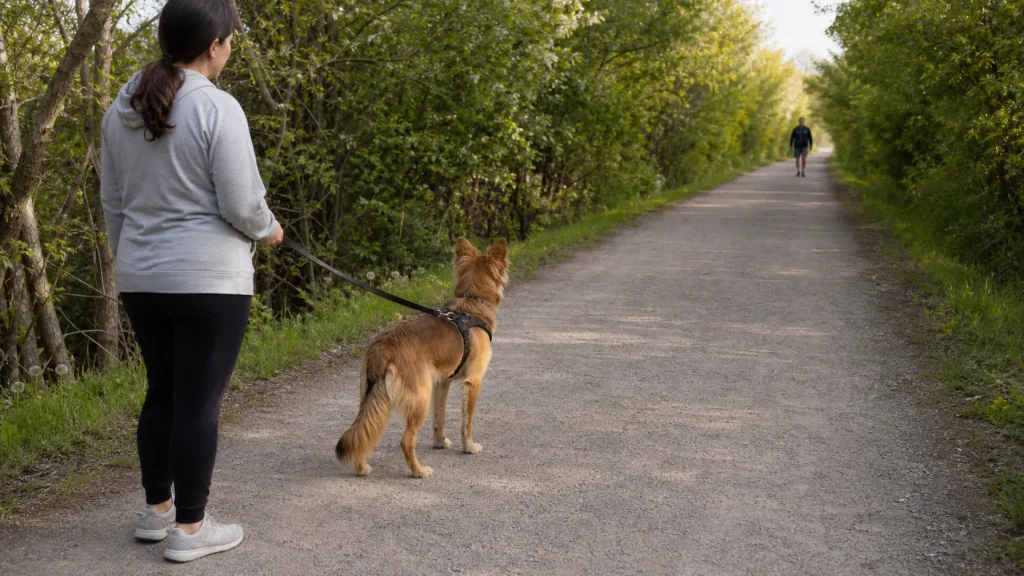
Many owners accidentally make leash barking worse by tightening the leash, scolding, or forcing greetings. From the dog’s view, a stranger appears, tension hits the collar or harness, the owner becomes upset, and the whole scene feels more intense. The dog may bark harder next time because barking seems connected to making the stranger go away.
A better plan is to work below threshold. Threshold means the distance where your dog can still eat, think, and respond. If your dog is barking, lunging, and refusing food, you are too close. Moving farther away is not failure. It is how you make learning possible.
This topic belongs in obedience because calm walking around people is a practical life skill. But it also touches behavior and emotion. If a dog is truly fearful or aggressive, the solution is not stricter commands. It is a training plan that changes the dog’s association with strangers while keeping everyone safe.
The most reliable path is to reduce the difficulty, reward the behavior you want, and build the skill in layers. This is also the approach supported by modern reward-based training guidance from veterinary and humane organizations. It may look slower at first, but it creates better long-term behavior because the dog understands what to do instead of simply learning what to avoid.
Method 1: Use Distance and Counterconditioning
Counterconditioning means changing how your dog feels about a trigger. Instead of strangers predicting stress, strangers begin to predict good things from you.
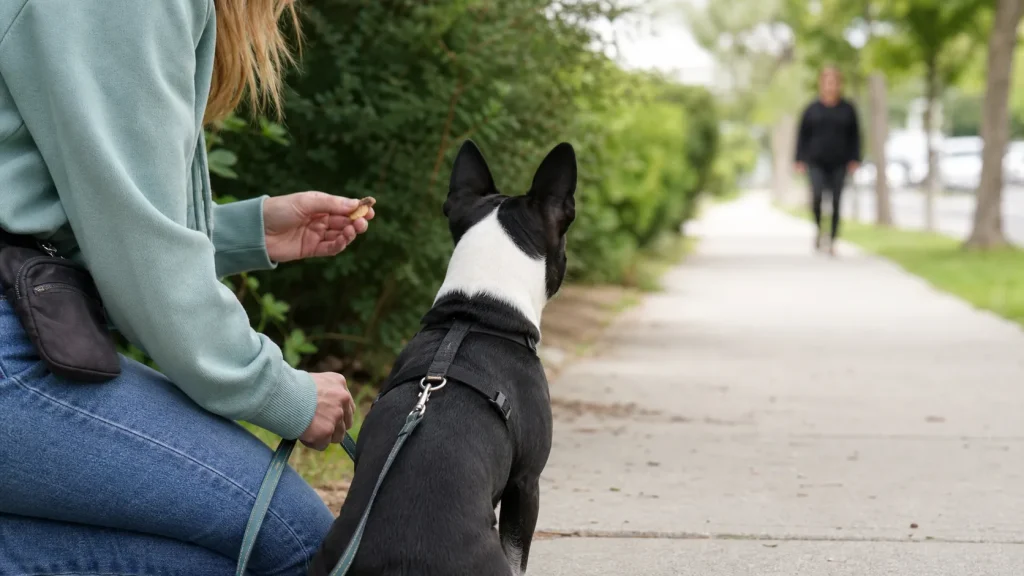
Step 1: Find the working distance
Stand far enough from a path, parking lot, or quiet street that your dog can notice a person without barking. This may be 20 feet for one dog and 150 feet for another.
Step 2: Mark the first look
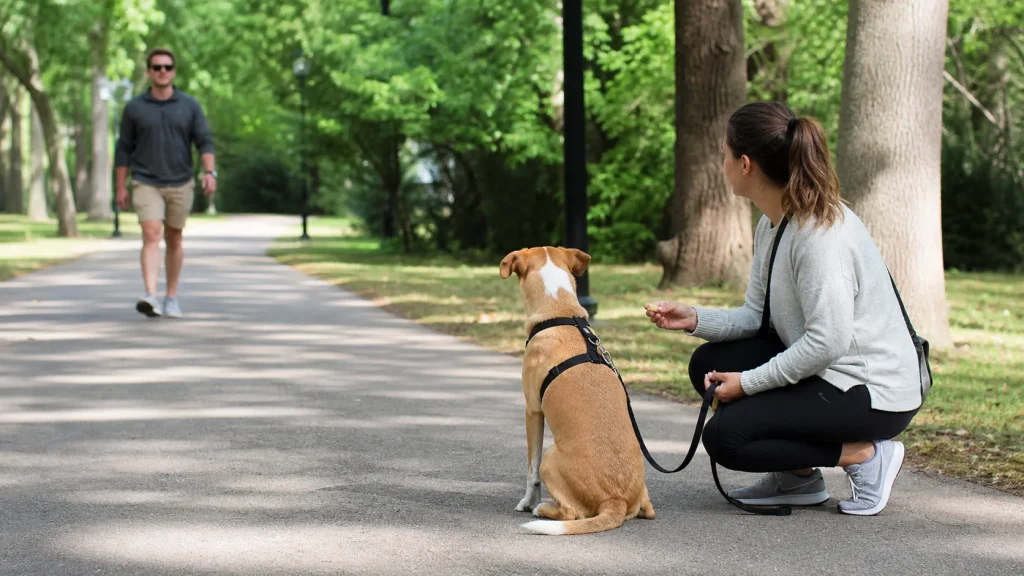
When your dog looks at a stranger calmly, say “yes” or click, then feed a high-value treat. You are rewarding awareness without escalation.
Step 3: Feed before the bark
Timing matters. If you wait until the dog is already barking, you are late. Feed when the dog sees the person and is still able to think.
Step 4: Let the stranger pass
Keep feeding small treats as the person moves through the environment. When the person disappears, the treats stop. This creates a simple pattern: stranger appears, good food appears.
Step 5: Add a turn-away cue
Teach “let’s go” or “this way” in easy places, then use it when a person is getting too close. Reward the dog for turning away with you.
Step 6: Shorten distance gradually
Only move closer when your dog can watch people calmly several times in a row. If barking returns, increase distance again. The dog is giving you data, not disobeying on purpose.
Keep the first sessions short enough that your dog finishes wanting more. In practical obedience training, five clean repetitions are more useful than twenty messy ones. When the dog is successful, the habit strengthens; when the dog rehearses the unwanted behavior, that habit strengthens too.
Method 2: Teach Replacement Behaviors for Walks
A replacement behavior gives your dog a job to do instead of barking. The best choices are simple and compatible with movement.
Step 1: Practice check-ins at home
Say your dog’s name once. When they look at you, mark and reward. Then practice in the yard, driveway, and quiet sidewalk before using it near strangers.
Step 2: Teach a hand target
Hold out your palm and reward your dog for touching it with their nose. A hand target can redirect the dog’s head and help them move past mild distractions.
Step 3: Use pattern games
Simple patterns such as count-to-three feeding can calm many dogs because the next reward becomes predictable. Predictability is useful for nervous dogs.
Step 4: Reward parallel movement
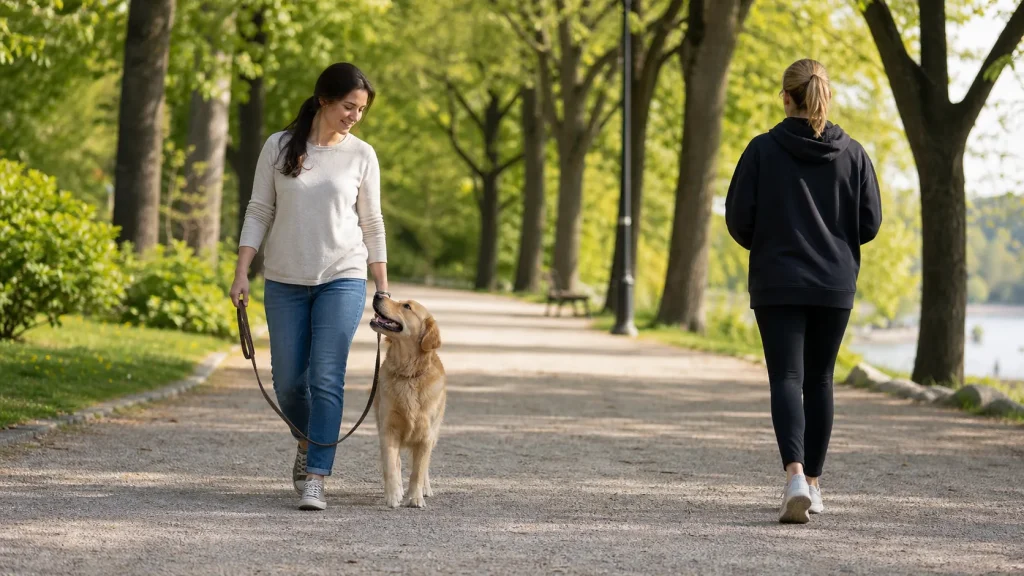
If a stranger is walking in the same direction at a distance, reward your dog for moving with you rather than staring. Movement often helps dogs process stress better than sitting still.
Step 5: Avoid forced greetings
A dog who barks at strangers does not need more surprise petting. Many dogs improve faster when owners stop allowing strangers to reach for them.
Step 6: End on success
If your dog calmly watches one person and turns away, that is a win. Leave before the environment becomes too hard. Good training walks are often shorter than normal walks.
Real-world training should feel slightly challenging but not chaotic. If your dog cannot eat, respond, or recover, the setup is too hard. Step back, simplify, and let the dog collect successful repetitions before trying again.
Tool Solution: Products That Can Support Training
No product replaces a good training plan, but the right gear can reduce risk and make timing easier. I evaluate training tools by comfort, safety, adjustability, durability, ease of cleaning, and whether the product helps the dog learn without intimidation.
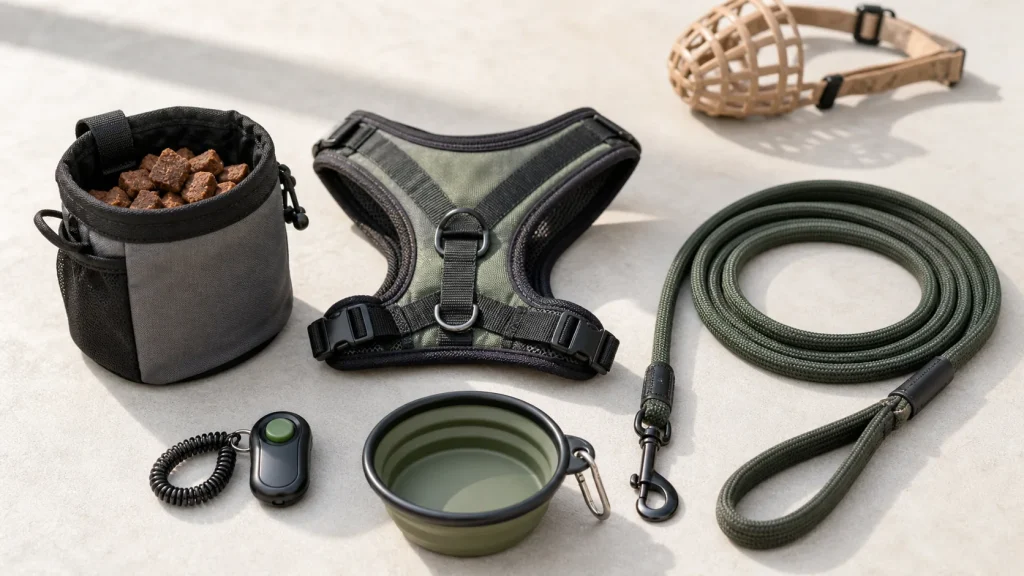
High-value treat pouch
Use soft, smelly treats that your dog will eat outdoors. If the dog refuses food, increase distance from the trigger.
Y-shaped harness
A comfortable harness reduces neck pressure and gives safer control during sudden movement. Fit matters more than brand.
Six-foot leash
A standard leash gives enough room to move without letting the dog build a long running start toward people.
Visual barrier
Parked cars, hedges, and building corners can help you create distance. I consider the environment one of the most underrated training tools.
Basket muzzle when needed
For dogs with a bite history, a properly conditioned basket muzzle can add safety. It should be introduced slowly with treats, never slapped on during a crisis.
When comparing products, avoid choosing only by star rating. Read the sizing chart, check return policies, and think about your specific dog: body shape, strength, chewing habits, sensitivity, and daily environment. The best obedience tool is the one you can use consistently and humanely.
Common Mistakes
Do not punish barking without addressing the trigger. Suppressing noise may leave the fear or frustration intact.
Do not ask strangers to feed your dog unless a qualified trainer has recommended that setup. For some dogs, food from strangers creates conflict and pressure.
Do not tighten the leash every time a person appears. Dogs notice that pattern and may become more alert.
Do not walk directly toward triggers for the sake of practice. Training should happen at a distance where your dog can succeed.
Do not expect progress to be perfectly linear. Reactive barking often improves in waves, especially during adolescence or stressful weeks.
Another mistake is expecting one perfect session to solve a rehearsed habit. Dogs learn through patterns. Your job is to make the desired behavior easier to repeat and the unwanted behavior less useful.
How to Tell Fear, Frustration, and Excitement Apart
A fearful dog may bark while leaning back, avoiding eye contact, tucking the tail, or trying to increase distance. This dog needs space and confidence-building.
A frustrated greeter may bark, pull forward, wag stiffly, and become upset because the leash prevents access. This dog needs impulse control and fewer on-leash greetings.
An overexcited dog may recover quickly after the person passes. Shorter walks, more sniffing, and reinforcement for calm check-ins can help.
A protective pattern often appears near the home, car, or owner’s body. Management and professional coaching are wise if the dog is difficult to interrupt.
If you are unsure, treat the situation conservatively. Increase distance, avoid greetings, and reward calm observation until a professional can assess the dog.
If progress stalls, look at the whole routine: sleep, exercise, enrichment, pain, stress, household consistency, and the difficulty of the environment. Obedience is not separate from daily life. A dog who is uncomfortable, overwhelmed, or under-stimulated will have a harder time learning.
Expert Review Notes: How I Judge Progress
When I test pet training products or evaluate a training plan, I do not judge success by one impressive moment. I look for repeatability. A dog who performs once in the kitchen has shown potential; a dog who can repeat the behavior in several realistic settings has started to build a dependable habit. For how to stop dog barking at strangers on walks, that difference matters because owners often move from practice to real life too quickly.
The first metric I watch is recovery time. A dog does not have to be perfect to be improving. If the dog notices a distraction, makes a mistake, and then recovers faster than last week, the training is working. Shorter recovery time usually means the dog is less overwhelmed and understands the pattern more clearly.
The second metric is handler consistency. The leash, crate, cue, mat, or treat pouch may look like the center of the plan, but the human rules are the real equipment. If the cue changes every session, the reward comes late, or one family member allows the old behavior, progress will wobble. Before blaming the dog, I always check whether the people are using the same criteria.
The third metric is environmental difficulty. A quiet living room, a suburban sidewalk, a pet store entrance, and a busy park are not the same classroom. Dogs do not generalize as automatically as humans expect. If your dog succeeds at home and fails outside, that does not mean the dog is being willful. It means the lesson needs to be rebuilt in smaller steps.
The fourth metric is body language. Good obedience should make the dog clearer and more relaxed over time. I want to see softer muscles, easier breathing, faster re-engagement, and a dog who can take food or respond to a simple cue. If the dog looks shut down, frantic, or conflicted, I would change the plan before I changed the product.
The fifth metric is durability. A plan is not finished when the behavior appears once. It is finished when the owner can maintain it with normal life rewards, occasional food reinforcement, and realistic management. That is why I prefer humane, reward-based training: it gives the dog information and motivation, not just pressure.
Troubleshooting: What to Do When Training Stalls
If your dog is not improving, reduce the difficulty before changing everything. Most obedience problems get worse when owners keep testing at a level where the dog is already failing. Move farther away, shorten the session, use better rewards, or return to a familiar location. Easier practice is not a step backward; it is how you rebuild clean repetitions.
If your dog ignores food, do not assume they are not food motivated. Many dogs stop eating when they are stressed, excited, too close to a trigger, physically uncomfortable, or already full. Try a quieter location, softer treats, smaller pieces, or a different time of day. If a normally hungry dog cannot eat in a training setup, the setup is probably too hard.
If progress is good for one person but poor for another, compare details. Voice tone, leash length, reward timing, walking speed, and body position can all change the picture for the dog. Have the more successful handler demonstrate the exact rhythm, then let the second person copy it in an easy setting.
If the behavior improves at home but disappears outside, add a middle step. Practice on the porch, in the garage, in the driveway, near a quiet parked car, or at the edge of a calm field. Many owners jump from indoor training straight to the hardest version of the problem. The middle steps are where reliability is built.
If your dog becomes more excited when treats appear, feed lower and slower. Deliver the treat where you want the dog to be, keep your hand movement calm, and use smaller pieces. For some dogs, the treat pouch itself becomes a distraction, so practice wearing it around the house without always training.
If you feel frustrated, stop the session before your handling gets sharp. Dogs are excellent readers of tension. A two-minute break, a simpler repetition, or a calm walk home can protect the training relationship. The best trainers I know are not the ones who never hit a rough moment; they are the ones who notice early and adjust.
Safety and Welfare Notes
Training should never put your dog, other people, or other animals at unnecessary risk. Use leashes, gates, distance, crates, harnesses, and controlled setups while the skill is still developing. Management is not a substitute for training, but it prevents bad rehearsals and keeps everyone safe during the learning process.
Avoid tools or techniques that rely mainly on fear, pain, or intimidation. They may interrupt behavior in the short term, but they can also increase stress, suppress warning signs, or damage trust. For most family dogs, reward-based training combined with thoughtful management is safer and more sustainable.
Health can affect obedience. Pain, digestive upset, poor sleep, hearing loss, vision changes, skin irritation, and medication changes can all alter behavior. If a dog suddenly starts failing a skill they previously knew, consider a veterinary check rather than assuming the dog has become stubborn overnight.
Finally, know when to ask for help. A certified reward-based trainer, veterinary behaviorist, or qualified behavior consultant can be worth it when the behavior involves fear, panic, aggression, escape risk, or a handler who feels physically unsafe. Good professional help should make the plan clearer, kinder, and more practical.
Practice Readiness Checklist
Before you practice how to stop dog barking at strangers on walks, make the session small enough that both you and your dog can succeed. Choose one skill, one location, one reward type, and one clear stopping point. A short session that ends cleanly is more valuable than a long session that turns into frustration.
Check the environment first. If there are too many strangers, dogs, noises, smells, visitors, or household interruptions, move farther away or practice indoors. Obedience training works best when the dog is aware of the world but still able to eat, respond, and recover.
Prepare the tools before the dog is excited. Have your leash, harness, crate setup, mat, treat pouch, long line, or gate ready before asking for behavior. Good setup prevents rushed handling and keeps the dog from rehearsing the habit you are trying to change.
Match rewards to difficulty. Kibble may work in the kitchen, but a busy sidewalk, night crate routine, or stranger passing on a walk may require softer, smellier, higher-value treats. If your dog cannot take food, reduce the challenge instead of pushing harder.
End with information, not blame. If the dog struggles, note what made the repetition too hard: distance, duration, distraction, timing, equipment, pain, fatigue, or handler inconsistency. That note tells you exactly how to make the next session fairer and more productive.
A Simple 7-Day Training Plan
Day 1: Identify your dog’s threshold distance around strangers.
Day 2: Practice name response and hand targets indoors.
Day 3: Watch people from a distance and feed before barking starts.
Day 4: Add a cheerful turn-away cue in easy locations.
Day 5: Practice parallel walking far from people on a quiet route.
Day 6: Reduce distance slightly only if your dog stayed calm earlier.
Day 7: Review which distances, routes, and rewards worked best.
This 7-day plan is a starting structure, not a promise that the behavior will be finished in a week. Some dogs need a few days; others need several months. The right pace is the one that keeps your dog learning without panic, frustration, or repeated failure.
FAQ
Is my dog barking at strangers because they are aggressive?
Not always. Barking can come from fear, frustration, excitement, or uncertainty. Aggression risk depends on the full body language and history.
Should I let strangers pet my barking dog?
Usually no. Forced greetings can increase pressure. Let your dog observe from a safe distance and choose calm disengagement.
Can I teach quiet as a command?
A quiet cue can help, but it should not be the whole plan. You still need to change how the dog feels and behaves around strangers.
Why does my dog bark more on leash than off leash?
The leash restricts movement and can increase frustration or fear. It also changes body language between dogs and people.
What treats work best for reactive barking?
Use high-value food such as chicken, cheese, or soft training treats. The reward must be strong enough for the environment.
When should I call a trainer?
Call a qualified trainer if your dog lunges hard, has bitten, cannot recover, or makes walks feel unsafe.
Will my dog grow out of barking at strangers?
Some puppies improve with careful exposure, but many dogs need structured training. Waiting can allow the behavior to become stronger.
Key Takeaways
- Barking at strangers is often emotional, not simple disobedience.
- Work below threshold so your dog can still learn.
- Reward calm looking and turning back to you.
- Avoid forced greetings and surprise petting.
- Distance is a training tool, not a failure.
- Punishment can make fear-based barking worse.
- Professional help is appropriate when safety is a concern.
Sources
- ASPCA: barking behavior in dogs
- American Kennel Club: how to stop dog barking
- American Veterinary Society of Animal Behavior: humane training position statements
- Humane Society of the United States: positive reinforcement training
- VCA Animal Hospitals: using reinforcement and rewards to train your pet