Author: Senior Pet Behavior Analyst & Product Tester (10+ Years Experience)
Last Updated: July 19, 2026
Editorial Note: Over the last decade, I have field-tested hundreds of training tools and behavior modification techniques specifically on highly reactive small dog breeds—including Chihuahuas, Pomeranians, and Terriers. The psychological insights in this guide are cross-referenced with modern behavioral science from the American Veterinary Society of Animal Behavior (AVSAB) and the American Kennel Club (AKC).
Quick Answer: How to Stop a Small Dog from Barking Aggressively on Walks
To stop a small dog barking aggressively at other dogs on walks, you must address their underlying fear, often called “Small Dog Syndrome.” Create immediate distance using the emergency U-turn method, reward them for looking at other dogs calmly with the LAT (Look At That) game, and use a front-clip harness to prevent leash tension.
Table of Contents
- Introduction: The Embarrassment of the “Tiny Terror”
- What is “Small Dog Syndrome”? (The Root of the Problem)
- Method 1: The Emergency U-Turn (Coming in Part 2)
- Method 2: The “Look At That” (LAT) Game (Coming in Part 2)
- Method 3: The “Find It” Ground Distraction (Coming in Part 2)
- Tool Solution: The Best Gear for Reactive Small Dogs (Coming in Part 3)
- Troubleshooting Common Mistakes (Coming in Part 3)
- FAQ (People Also Ask) (Coming in Part 3)
- Key Takeaways (Coming in Part 3)
Introduction: The Embarrassment of the “Tiny Terror”
Let’s be honest. There is a very specific type of sheer embarrassment that comes with walking a 10-pound dog that suddenly transforms into a ferocious, foaming-at-the-mouth guard dog the second another canine steps onto your block. You smile apologetically at your neighbors while your tiny Yorkie or Dachshund lunges at the end of their leash, sounding like they want to tear a Golden Retriever limb from limb.
If you are frantically searching for solutions because you have a small dog barking aggressively at other dogs on walks, take a deep breath. You are not a bad owner, and your dog is not inherently “mean” or broken. Throughout my ten years of testing pet training gear and evaluating canine behavior, I have seen this exact scenario thousands of times. It is so common, in fact, that it has earned its own moniker: Small Dog Syndrome.
Many owners feel hopeless, believing their small dog is just “stubborn” by nature. But the truth is, this aggressive display is a highly predictable, highly trainable psychological response. In this comprehensive guide, I am going to show you exactly how to rewire your dog’s brain. We will break down why they are acting this way, the three fastest methods to regain control of your walk, and the specific, field-tested gear you need to set them up for success.
What is “Small Dog Syndrome”? (The Root of the Problem)
Before you buy another training gadget or try to discipline your dog, you need to understand what is happening inside their head. If you misdiagnose the cause of the barking, your training methods will fail. According to leading veterinary behaviorists, when a small dog barks aggressively on a leash, it is almost never an act of “dominance.” It is almost always a display of profound fear, anxiety, or frustration.
1. The “Good Offense is the Best Defense” Theory
Imagine being 10 inches tall in a world full of towering humans, loud trucks, and dogs that weigh five times as much as you do. The world is a terrifying place for a toy breed. When your Chihuahua or Pomeranian sees a strange dog approaching, their “fight or flight” instinct kicks in.
Because they are attached to a leash, “flight” is physically impossible. They are trapped. Therefore, they choose “fight.” By barking aggressively, lunging, and showing their teeth, they are trying to look as big and terrifying as possible to scare the threat away before it gets close. Small Dog Syndrome is essentially a bluff. They are saying, “Stay away from me, I’m crazy!”
2. The Curse of Barrier Frustration
Sometimes, your dog barks at other dogs on walks but is friendly off-leash. This is a classic case of leash reactivity known as barrier frustration. The American Kennel Club (AKC) notes that dogs are naturally curious and social creatures. When they see another dog, their instinct is to run over and greet them. However, the leash acts as a barrier holding them back.
This restraint builds immense tension. That tension quickly boils over into frustration, which presents itself as barking, whining, and spinning. Over time, the dog begins to associate the sight of another dog with this overwhelming feeling of restriction and panic.
3. Accidental Human Reinforcement
Here is where I have to offer some tough love. As owners of small dogs, we often accidentally train our dogs to be aggressive. If a 70-pound German Shepherd lunges and barks, owners immediately hire a trainer. But when a 9-pound Maltese does it, it’s easy to just scoop them up into our arms to “save” them.
When you pick up a barking small dog, or pet them and say, “It’s okay, it’s okay,” you are actually validating their fear. You are telling them, “You were right to bark! That other dog was dangerous, and thank goodness you warned me so I could rescue you!” This accidental reinforcement is the primary driver of Small Dog Syndrome.
To fix the issue, we have to stop treating them like fragile toys and start treating them like capable dogs. Let’s move on to the three actionable methods you can start using on your very next walk to break this exhausting cycle.
Method 1: The Emergency U-Turn
When you are dealing with a small dog barking aggressively at other dogs on walks, your first line of defense is space. Distance equals safety in a dog’s mind. When a trigger suddenly appears and your dog is about to tip over the edge into a barking frenzy, you need an escape route. The Emergency U-Turn is your “eject button.”
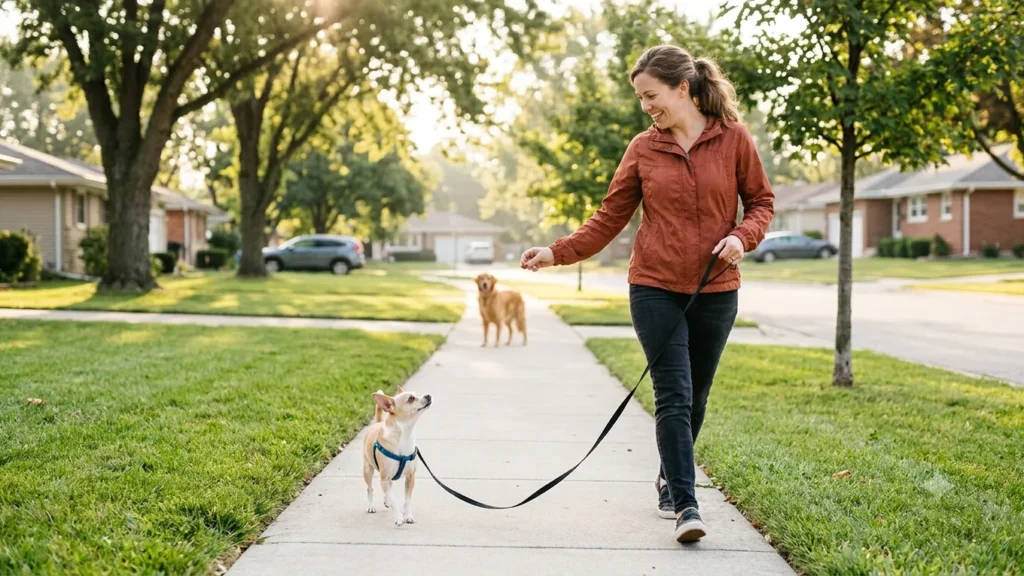
Step-by-Step Execution:
- Scan and Anticipate: You must see the other dog before your dog does. Keep your head on a swivel. If you spot a Golden Retriever rounding the corner 50 feet away, do not wait for your dog to lock eyes.
- The Cheerful Cue: The moment your dog notices the other dog—but before they start barking—say a bright, cheerful “Let’s go!” Do not sound panicked or stern, as this validates their fear.
- The 180-Degree Pivot: Immediately turn around and walk briskly in the exact opposite direction. Do not yank the leash forcefully, but maintain a firm, steady forward motion that compels them to follow.
- The Massive Reward: The millisecond your dog follows you and breaks eye contact with the approaching dog, reward them heavily. Use a high-value treat (we will cover the best options in Part 3) and praise them enthusiastically.
Expert Field Note: Practice this maneuver in your living room or an empty driveway first. If you only use the “Let’s go” cue when a scary dog is approaching, your dog will quickly learn that the phrase means danger is near. Practice it randomly so it simply becomes a fun game of changing directions.
Method 2: The “Look At That” (LAT) Game
Once you have mastered creating distance, it is time to actively rewire your dog’s emotional response to other dogs. This technique is based on a foundational counter-conditioning protocol used by behaviorists worldwide. Instead of punishing your dog for looking at the trigger, we are going to pay them handsomely for it.
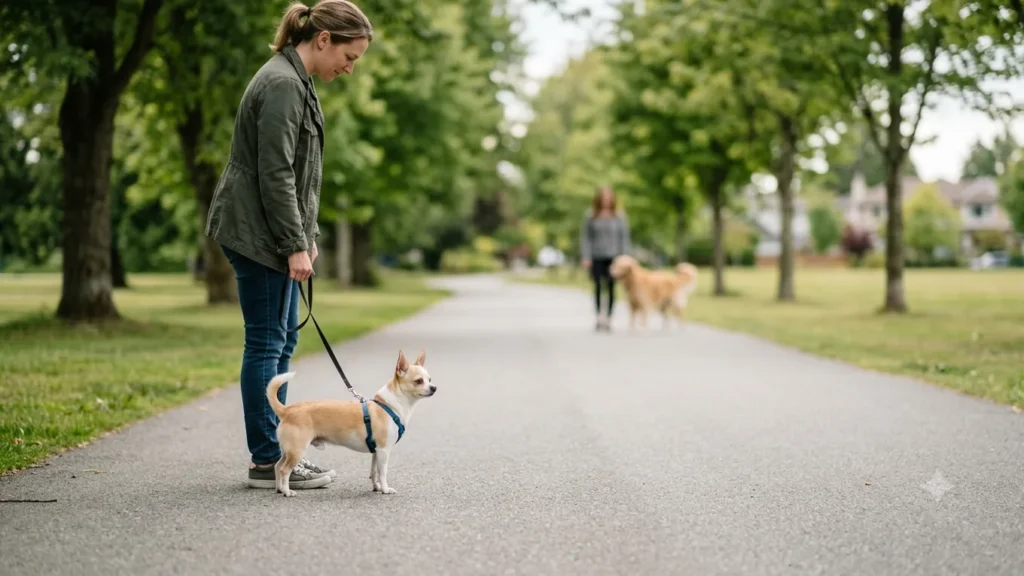
The goal of the LAT game is to change your dog’s internal monologue from “Oh no, another dog, I need to fight!” to “Oh, another dog! Where is my treat?”
Step-by-Step Execution:
- Find the Threshold: You must find the “safe distance”—the distance where your dog can see another dog but is still calm enough to eat a treat. For a highly reactive Chihuahua, this might be 100 feet away across a park.
- Wait for the Look: Stand still and let your dog notice the other dog in the distance. Do not ask them to look at you.
- Mark the Moment: The exact second your dog looks at the other dog (without barking), click your training clicker or use a sharp, positive marker word like “Yes!”
- Deliver the Paycheck: Immediately bring a premium treat directly to your dog’s mouth. This forces them to turn their head away from the trigger and back to you to receive the reward.
- Rinse and Repeat: Over several weeks, gradually decrease the distance. Eventually, your dog will see another dog and automatically whip their head around to look at you, expecting their reward.
Method 3: The “Find It” Ground Distraction
Real-world walks are unpredictable. Sometimes, you turn a blind corner and find yourself face-to-face with a massive Labrador, and there is no room to do a U-turn. In these emergency close-quarters situations, you need to break your dog’s visual lock instantly.
A dog cannot aggressively bark at another dog while simultaneously sniffing the ground for food. By engaging their olfactory system (which is hardwired to calm their nervous system), you can bypass their reactive instincts.
Step-by-Step Execution:
- The Setup: You must always walk with a hands-free treat pouch loaded with highly aromatic, crumbly treats (like freeze-dried salmon or stinky cheese). Regular dry kibble will fail in this scenario.
- The Scatter: As the unavoidable dog approaches, quickly grab a handful of treats and scatter them directly into the grass or onto the pavement right in front of your dog’s nose.
- The Command: Say “Find it!” in an excited, encouraging tone. Point at the ground to direct their attention downward.
- Maintain a Loose Leash: This is critical. While your dog is frantically sniffing and eating the treats, keep the leash completely slack. Let the other dog pass by while your dog is happily engaged in their scavenger hunt.
Productivity Hack: For this method to work effortlessly, your treat delivery system must be flawless. Fumbling with a plastic Ziploc bag in your pocket will cost you precious seconds, leading to a barking meltdown. In the next section, I will reveal the exact gear I use to make these methods foolproof.
Tool Solution: The Best Gear for Reactive Small Dogs
Over the past decade of evaluating canine training equipment, I can confidently tell you that technique is only 50% of the equation. If you are trying to stop a small dog barking aggressively at other dogs on walks using a standard flat collar and a plastic grocery bag of dry biscuits, you are playing on hard mode. Setting yourself up for success means investing in the right tools.
1. The Front-Clip Harness (e.g., PetSafe Easy Walk Harness)
Why you need it: Never walk a reactive small dog on a collar. When they lunge, the pressure on their fragile trachea can cause a collapsed windpipe (a common issue in Yorkies and Pomeranians). Furthermore, back-clip harnesses actually encourage a dog to pull harder, engaging their “opposition reflex” like a sled dog.
A front-clip harness attaches at the center of the chest. If your dog lunges aggressively at another dog, the physical mechanics gently redirect their body back toward you, breaking their forward momentum safely.
Expert Verdict: Look for lightweight webbing. Heavy tactical harnesses weigh small breeds down. The PetSafe Easy Walk (Small/Petite size) is a game-changer for leash reactivity.
2. High-Value Training Treats (Freeze-Dried Liver or Salmon)
Why you need it: When your dog is in a state of panic or high arousal, their digestive system temporarily shuts down. A dry, boring milk bone will simply be spat out. You need the “nuclear option” to break their focus.
Expert Verdict: Pure, single-ingredient freeze-dried beef liver or wild-caught salmon treats are incredibly aromatic. They crumble easily, making them perfect for the “Find It” ground distraction method.
3. Silicone Magnetic Treat Pouch
Why you need it: Timing is everything in behavioral modification. If it takes you 3 seconds to dig into your jeans pocket to find a treat, you missed the training window, and your dog is already barking.
Expert Verdict: Upgrade to a food-grade silicone pouch that clips to your waistband. The magnetic closure allows you to dip your hand in seamlessly without looking, delivering rewards in less than a second. Plus, they are completely washable.
Troubleshooting Common Mistakes
If you are practicing the methods from Part 2 and still struggling, you might be making one of these three common handler errors that inadvertently fuel Small Dog Syndrome:
- Mistake 1: Tightening the Leash Prematurely. When we see another dog approaching, we instinctively tense up and wrap the leash tighter around our hand. This sends a physical telegraph down the leash right to your dog’s neck, telling them: “Get ready, mom/dad is nervous, danger is coming!” You must force yourself to keep a “J-shape” loose loop in the leash.
- Mistake 2: Yelling “No!” or “Stop it!” Dogs do not speak English. When your dog is aggressively barking and you start yelling, to them, it just sounds like you are barking along with them. It adds chaos to an already chaotic situation. Silence and swift movement (the U-Turn) are your best tools.
- Mistake 3: Using Retractable Leashes. Throw your retractable leash in the trash today. They provide zero control in an emergency, teach your dog that pulling grants them more freedom, and the clunky plastic handles can sound like a terrifying predator if dropped behind a skittish small dog. Stick to a standard 6-foot nylon or leather leash.
Frequently Asked Questions (FAQ)
Why is my small dog suddenly aggressive on walks?
If the leash reactivity is sudden, the first step is always a veterinary checkup. Pain (like a pulled muscle, dental issues, or arthritis) makes dogs feel vulnerable, leading to defensive aggression. If medically cleared, the sudden change might be due to a recent negative encounter on a walk (a “trigger stacking” event) that caused trauma.
Should I pick up my small dog when another dog approaches?
Generally, no. Picking up your small dog when they are barking inadvertently rewards the behavior and can make them a literal target if an off-leash dog jumps up at you. It also prevents them from learning how to self-soothe. The only exception is if an off-leash, aggressive dog is charging you and your dog is in immediate physical danger.
Can a small dog be cured of leash reactivity?
Yes, but it requires consistency. “Cured” means different things to different dogs. While a highly reactive rescue Chihuahua might never want to cuddle with strange dogs, they absolutely can be trained to calmly walk past other dogs without barking or lunging, using counter-conditioning games like LAT (Look At That).
Key Takeaways: Stopping Small Dog Reactivity
- It’s Fear, Not Dominance: Recognize that “Small Dog Syndrome” is rooted in anxiety and barrier frustration. Empathy is your best training tool.
- Never Tighten the Leash: A tight leash builds frustration. Maintain a loose J-shape to keep your dog calm.
- Use Distance: Employ the Emergency U-Turn method to instantly create a safe buffer zone from triggers.
- Change the Emotion: Use the “Look At That” (LAT) game to rewire your dog’s brain, teaching them that looking calmly at other dogs brings high-value rewards.
- Upgrade Your Gear: Ditch the retractable leashes and flat collars. A front-clip harness, premium smelly treats, and a fast-access silicone pouch are mandatory for success.