Author: Senior Pet Product & Behavior Analyst (10+ Years of Field Testing)
Last Updated: July 14, 2026
Editorial Note: Over the past decade, I have rigorously tested hundreds of training tools, puzzle toys, and behavior modification techniques. The strategies detailed below have been field-tested on breeds ranging from highly active Border Collies to senior rescue dogs. The behavioral science referenced in this article aligns with guidelines from the American Kennel Club (AKC).
Quick Answer: How to Mentally Tire a Dog Indoors
The fastest way to mentally tire a dog indoors is through scent work and problem-solving. In just 15 minutes, you can drain their energy by playing the “Find It” treat game, using DIY puzzle toys like a muffin tin with tennis balls, or serving their meals on a frozen lick mat. Scientific studies show that 15 minutes of intense mental stimulation burns as much energy as a brisk physical walk.
Table of Contents
- Introduction: Surviving the Rainy Day Zoomies
- Why Physical Exercise Isn’t Always Enough (The Athlete Effect)
- Method 1: The “Find It” Scent Game (Zero Cost) (Coming in Part 2)
- Method 2: The DIY Muffin Tin & Tennis Ball Puzzle (Coming in Part 2)
- Method 3: The “Which Hand?” Focus Game (Coming in Part 2)
- Tool Solution: The Best Products for Indoor Mental Stimulation (Coming in Part 3)
- FAQ (People Also Ask) (Coming in Part 3)
- Key Takeaways (Coming in Part 3)
Introduction: Surviving the Rainy Day Zoomies
Picture this: It is pouring rain outside, the temperature has dropped to freezing, or perhaps you are stuck in back-to-back Zoom meetings for your remote job. You look down, and your dog is staring a hole through your soul, a squeaky toy in their mouth, practically vibrating with unspent energy. If you are wondering how to quickly calm them down without a two-mile hike, you are in the right place.
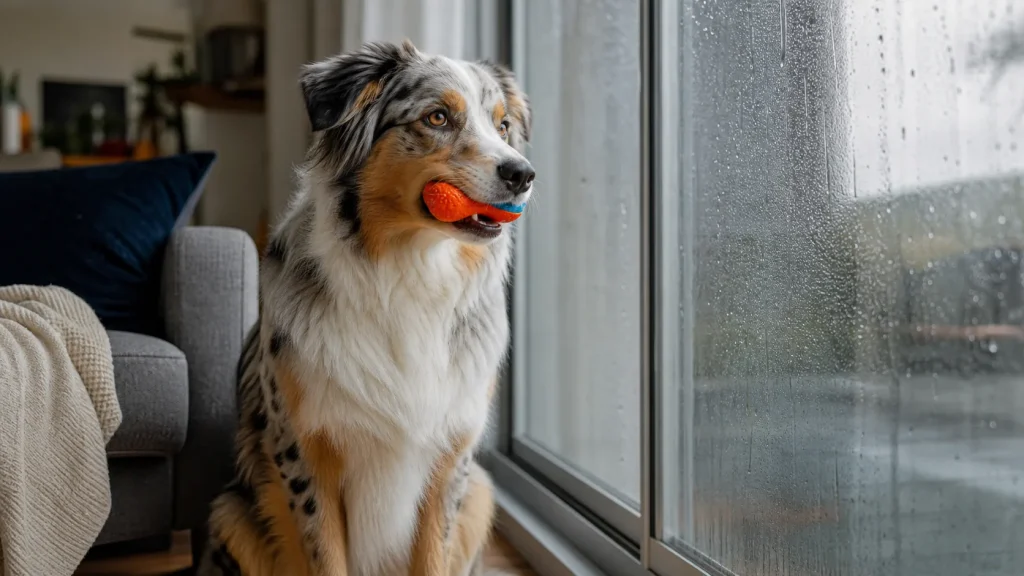
Throughout my 10 years as a pet product tester and behavior analyst, the most common plea for help I receive from overwhelmed dog owners is how to handle a bored, hyperactive pup when leaving the house isn’t an option. Whether you are searching for indoor mental stimulation games for high energy dogs like Australian Shepherds, or gentle mental stimulation for senior dogs indoors who can no longer handle long walks, the secret weapon is the same: brain work.
You do not need a massive backyard or expensive agility equipment to cure your dog’s boredom. In this comprehensive guide, I am going to show you how to leverage your dog’s natural instincts—sniffing, foraging, and problem-solving. I will share my top field-tested, highly effective mental stimulation games for dogs indoors that require 15 minutes or less. By the end of this article, you will have a toolkit of quick indoor brain games for bored dogs that will leave your furry best friend happily snoring on the couch.
Why Physical Exercise Isn’t Always Enough (The Athlete Effect)
Before we dive into the games, we need to address a massive misconception in the dog training world. When a dog is acting out, chewing furniture, or barking excessively, the standard advice is usually: “A tired dog is a good dog. Just walk them more!”
While physical exercise is absolutely crucial for cardiovascular health, relying on it entirely is a trap. I call this the “Athlete Effect.”
The Problem with Building an Athlete
If you have a young Golden Retriever and you start running them 5 miles every day to tire them out, they will be exhausted for the first few weeks. But dogs adapt incredibly fast. Soon, that 5-mile run becomes their new baseline. You haven’t taught them how to be calm; you have just conditioned a super-athlete with immense stamina. When a rainy day hits and you can’t do that 5-mile run, their energy explodes into destructive behaviors.
According to veterinary behaviorists and the AKC, physical exercise works the muscles, but mental exercise works the nervous system. When a dog uses their nose to process complex scents or solves a puzzle to access food, their brain uses a massive amount of glucose.
Brain vs. Brawn: The 15-Minute Rule
In my decade of behavioral observation, I have consistently seen this formula hold true: 15 minutes of intense mental stimulation tires a dog out as much as a 1-mile physical walk.
When you force a dog to think, focus, and sniff, you are fulfilling their genetic drive. Working breeds were bred to herd sheep, track scents, and retrieve game. When we put them in a modern living room with nothing to do, they become frustrated. DIY mental stimulation games for dogs indoors give them a “job.” It lowers their cortisol (stress hormone) levels and increases endorphins, leading to a deep, satisfying sleep rather than the restless pacing you get from a dog who is physically fit but mentally bored.
Now that you understand why brain games are the ultimate hack for modern dog owners, let’s break down the exact, step-by-step games you can start playing right now, using items you already have in your kitchen.
Method 1: The “Find It” Scent Game (Zero Cost)
If I were stranded on a desert island with a high-energy dog and could only choose one game to play for the rest of my life, it would be scent work. A dog’s nose is a biological marvel. While humans rely on sight, dogs “see” the world through smell. A staggering portion of a dog’s brain is dedicated entirely to analyzing odors.
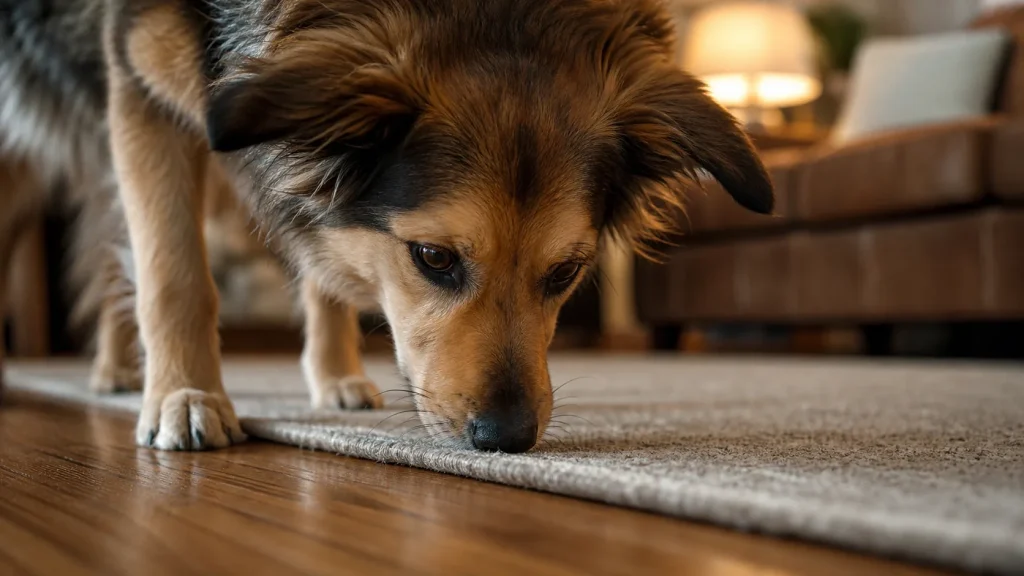
When you ask a dog to hunt for a specific scent, you are forcing their brain into overdrive. This is one of the most effective quick indoor brain games for bored dogs, and the best part? It costs absolutely nothing.
Step-by-Step Execution:
- Level 1 (Visual Tracking): Start simple so your dog doesn’t get frustrated. Put your dog in a “Sit” and “Stay” command. Walk a few feet away, place a high-value, smelly treat (like a tiny piece of cheese or freeze-dried liver) on the floor where they can clearly see it. Walk back to them, point to the treat, and say enthusiastically, “Find it!” Praise them when they eat it.
- Level 2 (Blind Sniffing): Once they understand the command, make it harder. Put them in a “Stay,” but this time, place the treat behind a table leg, under a small towel, or on the edge of a low bookshelf. Say “Find it!” Now, they actually have to engage their nose instead of just their eyes.
- Level 3 (The Ultimate Hunt): Put your dog in another room or their crate. Take 5 or 6 small treats and hide them all over your living room—under the edge of the rug, behind the couch pillows, on the TV stand. Release the hound!
Expert Field Note: Watching a dog systematically clear a room using their nose is incredible. Just 15 minutes of advanced “Find It” will have a hyperactive puppy panting as if they just ran a sprint. It’s the ultimate mental stimulation for senior dogs indoors too, as it requires zero jumping or running.
Method 2: The DIY Muffin Tin & Tennis Ball Puzzle
You don’t always need to drop $30 on a fancy puzzle toy from a pet store. In fact, one of my favorite DIY mental stimulation games for dogs indoors uses items you probably already have in your kitchen and garage.
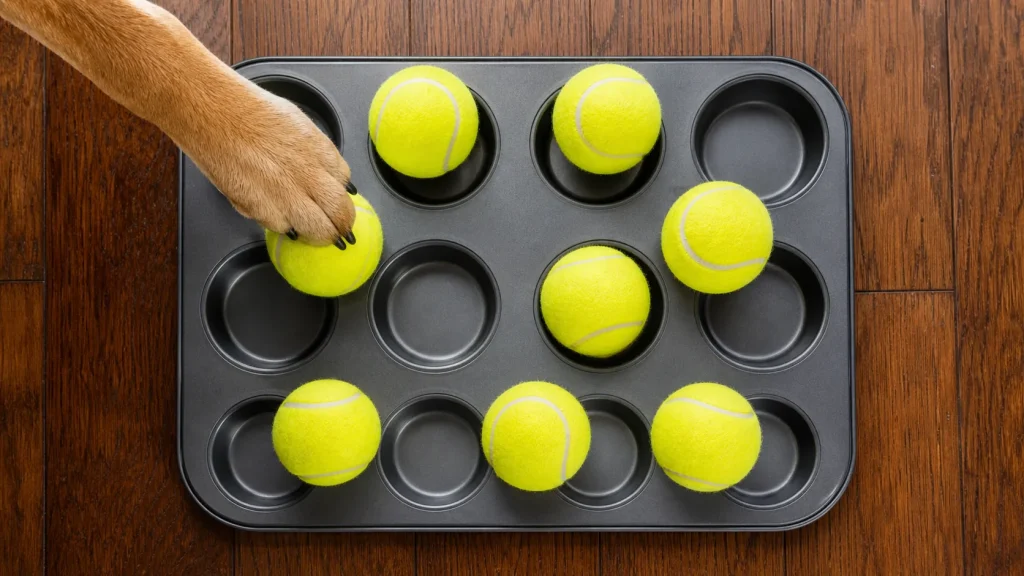
This game is perfect for beginners and teaches your dog basic problem-solving skills (moving an obstacle to reveal a reward). It is highly engaging, tactile, and provides immediate gratification.
How to Set It Up:
- Gather the Supplies: You will need a standard 12-cup metal or silicone baking muffin tin, up to 12 tennis balls, and a handful of your dog’s regular kibble or small training treats.
- Bait the Tin: Drop a few pieces of kibble into 4 or 5 random cups in the muffin tin. Leave the rest empty.
- Place the Obstacles: Place a tennis ball over every single cup in the tin—both the empty ones and the ones containing food.
- Let Them Solve It: Place the tin on the floor. Your dog will quickly smell the hidden food, but they have to figure out how to pick up or nudge the tennis balls out of the way to get their reward.
Troubleshooting Tip: If your dog is timid and scared of the metal clanking sound, use a silicone muffin mold or place the metal tin on a thick rug to muffle the noise. If they try to flip the entire tray over with their paw, gently hold the edges of the tray down and encourage them to use their nose.
Method 3: The “Which Hand?” Focus Game
What if you are right in the middle of your workday, stuck in front of your computer, and your dog starts nudging your elbow with a wet nose? You don’t have time to set up a scavenger hunt or bake a puzzle. You need a fast, low-prep distraction.
The “Which Hand?” game is an excellent, rapid-fire impulse control exercise. It forces your dog to concentrate intensely on you, overriding their zoomie instincts.
How to Play in 5 Minutes or Less:
- The Setup: Grab a highly aromatic treat. Sit on the floor or in your office chair facing your dog. Show them the treat so they know what’s at stake.
- The Shuffle: Put both hands behind your back and place the treat in one hand. Make tight fists with both hands.
- The Presentation: Present both closed fists to your dog simultaneously, holding them about a foot apart.
- The Choice: Let your dog sniff both hands. They will usually paw or aggressively nudge the hand that smells like the treat.
- The Reveal: If they guess correctly, immediately open the hand, say “Yes!” and let them eat the treat. If they guess incorrectly (pawing the empty hand), open the empty hand, say a gentle “Oops,” put your hands behind your back, and reset the game.
Productivity Hack: I keep a small jar of freeze-dried salmon treats on my desk. Playing 10 rounds of “Which Hand?” takes barely 3 minutes, but the intense concentration required usually convinces my hyperactive rescue dog to go back to her bed and settle down for another hour of my workday.
Tool Solution: The Best Products for Indoor Mental Stimulation
While DIY games are fantastic, sometimes you just need to hand your dog something pre-made so you can focus on cooking dinner or jumping on a conference call. Over my 10 years of reviewing pet products, I’ve seen hundreds of gimmicky toys break in five minutes. If you want true, lasting mental stimulation games for dogs indoors, you only need to invest in a few high-quality staples.
1. The Snuffle Mat (For Natural Foraging)
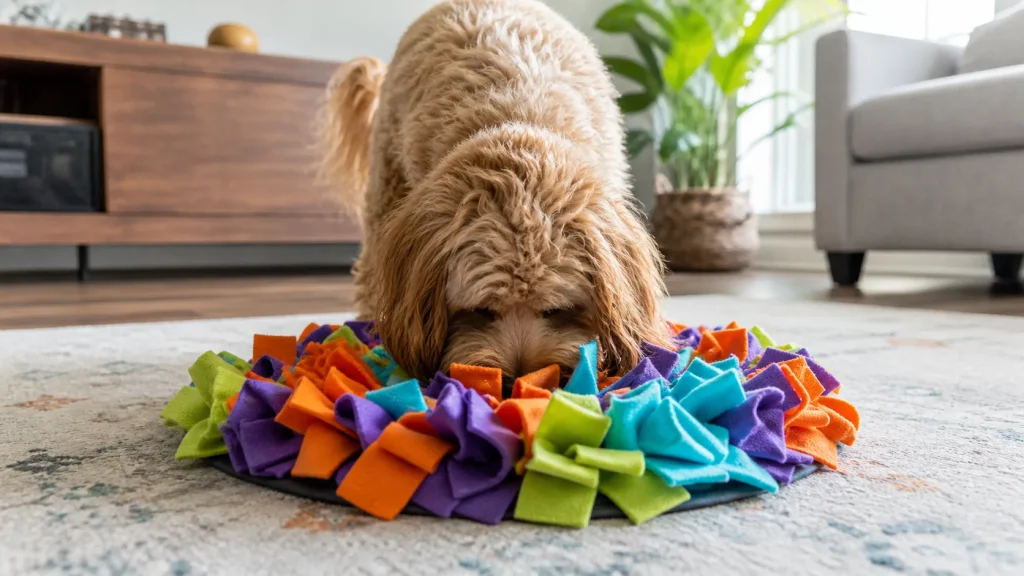
Why it works: A Snuffle mat is essentially a heavy-duty fabric mat covered in fleece strips. You hide dry kibble or treats deep within the fabric, and your dog has to use their nose to root around and find the food. It perfectly mimics the natural canine behavior of foraging for food in tall grass.
Expert Verdict: This is my #1 recommendation for mental stimulation for senior dogs indoors or dogs recovering from surgery, as it requires zero mobility but offers massive olfactory engagement.
2. LickiMat / Licking Mats (The Anxiety Reliever)
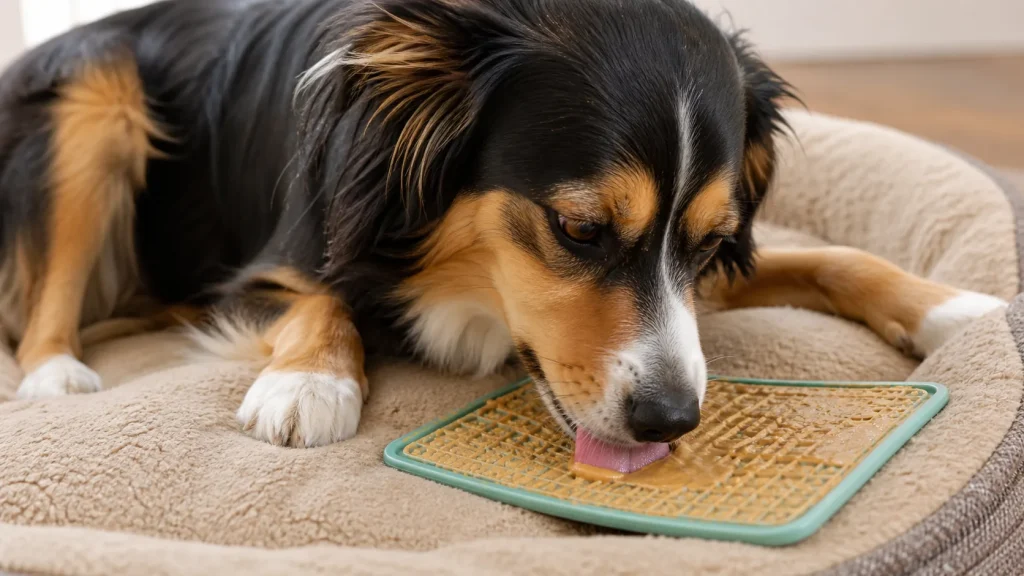
Why it works: The act of licking releases endorphins in a dog’s brain, naturally lowering their heart rate and soothing anxiety. You spread wet food, plain Greek yogurt, or dog-safe peanut butter across the textured rubber surface.
Pro-Tip for Fast Exhaustion: Do not just give them a room-temperature LickiMat. Smear the food on it and freeze it solid overnight. A frozen lick mat will keep a highly driven dog occupied for 30 to 45 minutes, acting as a massive cognitive drain.
3. Nina Ottosson Dog Puzzles (Level 2)
Why it works: When it comes to commercial puzzles, Nina Ottosson dog puzzles (now under Outward Hound) are the gold standard. I usually recommend starting with a Level 2 (Intermediate) puzzle. Dogs have to paw at levers, slide blocks, and lift bone-shaped covers to reveal treats.
Expert Verdict: Perfect for working breeds. It forces them to use sequential problem-solving logic. If they get too aggressive and try to chew the plastic, you must step in and show them how to use their nose or paws gently.
4. The KONG Wobbler
Why it works: Unlike the classic rubber KONG that you stuff and freeze, the KONG Wobbler is a hard plastic, weighted dispenser. It sits upright until your dog nudges it with their nose or paw, at which point it spins and wobbles unpredictably, occasionally dispensing a piece of kibble.
Expert Verdict: One of the best indoor mental stimulation games for high energy dogs. Replace their regular food bowl with this. Working for their dinner extends mealtime from 30 seconds to 20 minutes of intense physical and mental focus.
Frequently Asked Questions (FAQ)
How much mental stimulation does a dog need a day?
As a general rule, most average-energy adult dogs benefit from at least two 15-minute sessions of dedicated mental stimulation per day, in addition to their regular physical walks. However, working breeds (like Border Collies, Malinois, or Poodles) may require significantly more cognitive engagement to prevent boredom and destructive behaviors.
Does mental stimulation tire a dog out as much as a walk?
Yes. Engaging a dog’s olfactory system (sense of smell) and problem-solving cognitive functions requires a tremendous amount of energy. Behavioral experts often note that 15 to 20 minutes of intense sniffing and brain games can exhaust a dog just as thoroughly as a brisk 1-mile physical walk, making it the perfect substitute on rainy days.
What if my dog gets frustrated with puzzle toys?
If your dog whines, barks, or tries to aggressively chew the puzzle toy, the game is too hard. Mental stimulation should build confidence, not frustration. Always downgrade the difficulty. Start by leaving the puzzle compartments open so they can easily access the treat, and only increase the difficulty when they clearly understand the mechanics of the game.
Key Takeaways: Curing Dog Boredom Fast
- Balance is Key: Physical exercise builds stamina; mental exercise creates a calm, fulfilled dog. You need both.
- The 15-Minute Rule: Just 15 minutes of intense mental stimulation games for dogs indoors can drain as much energy as a long walk.
- Use Their Nose: The “Find It” scent game is free, requires zero prep, and is the most biologically fulfilling game you can play with a dog.
- Ditch the Food Bowl: Stop feeding your dog out of a metal bowl. Use a Snuffle Mat, a frozen LickiMat, or a KONG Wobbler to turn mealtime into a 20-minute brain game.
- Prevent Frustration: Whether using DIY methods like the muffin tin or commercial puzzles, always start at Level 1 and help your dog succeed before making the game harder.