By Marcus Vance | 10-Year Pet Product Testing Expert & Canine Behavior Specialist
Updated: July 14, 2026
Quick Answer
Can you work full-time with an 8-week-old puppy? Yes, but it requires a strict setup and lowered expectations. At 8 weeks old, a puppy can only hold its pee for about 2 to 3 hours. A realistic 8 week old puppy schedule for working owners involves a highly structured early morning routine, a mandatory mid-day visit (by you or a professional dog walker), and a secure Wire dog crate combined with a Puppy playpen setup. This hybrid containment strategy keeps them safe, prevents accidents from ruining your floors, and enforces the mandatory 18 to 20 hours of sleep they need for healthy brain development.
Table of Contents
- 1. The Reality of Leaving an 8-Week-Old Puppy While You Work
- 2. Method 1: The “Mid-Day Check-In” Schedule (Highly Recommended) [Coming in Part 2]
- 3. Method 2: The “Playpen + Pee Pad” Hybrid Schedule [Coming in Part 2]
- 4. Method 3: The “Split-Shift” Schedule for Couples [Coming in Part 2]
- 5. Essential Gear to Make Your Workday Stress-Free [Coming in Part 3]
- 6. How to Handle the Post-Work “Puppy Witching Hour” [Coming in Part 3]
- 7. Frequently Asked Questions (FAQ) [Coming in Part 3]
- 8. Key Takeaways [Coming in Part 3]
The Reality of Leaving an 8-Week-Old Puppy While You Work
Over my last ten years of reviewing thousands of pet products—from heavy-duty containment systems to high-tech pet cameras—and consulting with countless overwhelmed new dog owners, I have noticed one recurring theme: the clash between internet idealism and harsh reality. If you search online for an 8 week old puppy feeding and sleeping schedule, you will find beautifully color-coded charts that assume you are a stay-at-home parent with nothing else to do but watch your dog.
Let me be completely blunt: if you work a standard 9-to-5 job in the US market, those “perfect” schedules are not just unrealistic; they are a fast track to burnout and behavioral issues for your dog.
The Physiological Bottleneck: Why 8 Weeks is the Hardest Stage
When you bring a puppy home at 8 weeks, you are dealing with a baby animal that has almost zero muscle control over its bladder and bowels. According to guidelines set by the American Kennel Club (AKC), the golden rule of bladder capacity is “the puppy’s age in months plus one.” Therefore, a 2-month-old (8-week) puppy maxes out at about 3 hours of holding it—and that is usually while they are sleeping. When awake, active, or playing, that window shrinks drastically to 30 to 45 minutes.
Furthermore, breed size matters immensely. If you are looking for an 8 week old golden retriever puppy schedule, you might have slightly more wiggle room with bladder capacity compared to an 8-week-old Chihuahua or Yorkie, whose tiny bladders process water much faster.
The Sleep Deficit Danger
Another major factor working owners misunderstand is the necessity of sleep. An 8-week-old puppy needs roughly 18 to 20 hours of sleep per day. When owners leave for work, they often assume the puppy will naturally sleep the entire time. However, without a structured environment, an anxious puppy will pace, whine, and chew out of distress, leading to exhaustion. As a product tester, I’ve set up motion-activated cameras in dozens of homes. The data is clear: puppies left to free-roam or placed in oversized rooms without enforced nap protocols do not sleep. They stress.
This lack of sleep directly translates to the biting, nipping, and “demon dog” behavior you experience when you finally walk through the door at 5:30 PM. They aren’t just happy to see you; they are dangerously overtired and overstimulated.
The Psychological Risk: Separation Anxiety
Leaving an 8-week-old puppy completely isolated for 8 to 10 hours straight is scientifically detrimental. The American Veterinary Medical Association (AVMA) notes that dogs are inherently social pack animals. Sudden, prolonged isolation during their critical socialization period (which peaks between 8 and 16 weeks) is a primary trigger for severe separation anxiety later in life.
When working owners ask me for an 8 week puppy potty training schedule, I always pivot the conversation to environmental management. You cannot actively potty train a dog when you are sitting in a cubicle 20 miles away. What you can do is manage their environment using specific tools—like a properly sized wire dog crate or a sturdy playpen—to ensure they don’t practice bad habits while you are gone.
The core problem isn’t that you work full-time. The problem is trying to apply a stay-at-home schedule to a working-owner lifestyle. In the next sections, we are going to ditch the fairy-tale advice and break down three battle-tested, pragmatic schedules designed specifically for the modern working professional. We will look at how to balance your career with your puppy’s absolute biological needs, ensuring you survive the first few weeks without destroying your house—or your sanity.
Method 1: The “Mid-Day Check-In” Schedule (Highly Recommended)
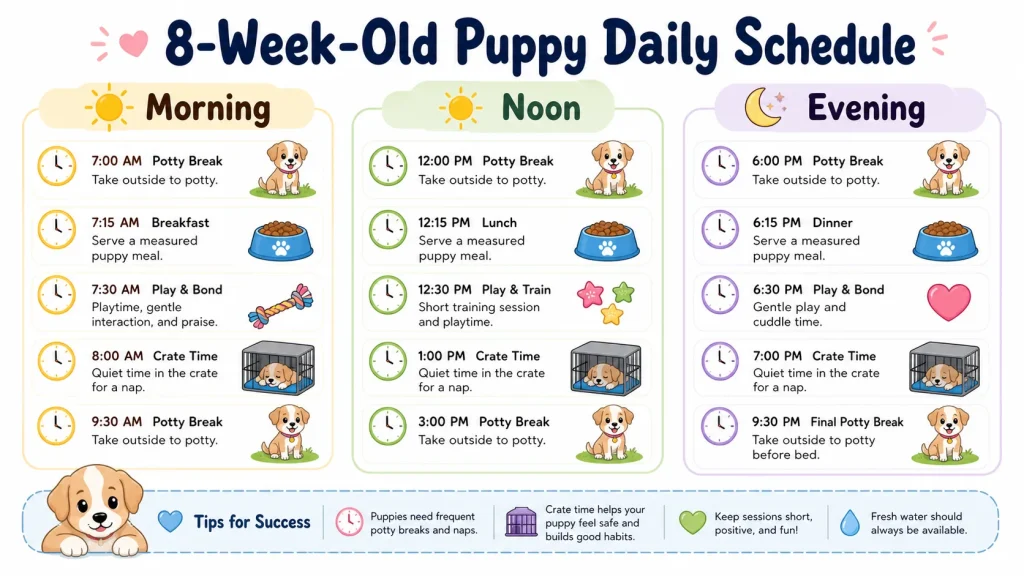
In my ten years of analyzing canine routines and testing home integration setups, the “Mid-Day Check-In” is the gold standard of 8 week old puppy schedule for working owners. This method works incredibly well because it respects the natural biological limits of an 8-week-old puppy’s bladder while utilizing the secure boundaries of a Wire dog crate.
By breaking your 8-hour workday into two manageable 4-hour blocks, you prevent your puppy from experiencing bladder distress, reduce the risk of accidents, and establish a clear routine. If your office is within a 15-minute drive, you can easily do this during your lunch break. If not, I highly recommend hiring a professional dog walker or pet sitter through trusted platforms like Rover or Wag! for this critical 30-minute visit.
Step-by-Step “Mid-Day Check-In” Routine
Step 1: The Morning Launch (6:00 AM – 8:00 AM)
- 6:00 AM – Immediate Potty: The moment you wake up, carry your puppy directly to their designated outdoor potty spot. Do not let their paws touch the floor inside, or they will pee out of excitement.
- 6:15 AM – Breakfast Time: Offer their first meal of the day. Keeping a strict 8 week old puppy feeding and sleeping schedule means feeding them at the exact same times daily. Give them 15-20 minutes to eat, then pick up the bowl.
- 6:30 AM – Second Potty Trip: Most puppies will need to poop 10 to 30 minutes after eating due to their gastrocolic reflex. Take them out again.
- 6:45 AM – Structured Play & Training: Spend 15 minutes working on basic commands (like “Sit” or “Attention”) and playing with interactive toys. Mental stimulation tires out a young puppy much faster than physical running.
- 7:30 AM – Final Potty & Water Prep: One last quick trip outside. 15 minutes before you walk out the door, remove all access to water to prevent them from overfilling their bladder right before crate time.
- 7:45 AM – Crate Transition: Place them in their crate with a safe chew toy (like a classic rubber toy stuffed with a few kibbles). Walk away calmly without making a dramatic goodbye.
Step 2: The Mid-Day Rescue (12:00 PM – 12:45 PM)
- 12:00 PM – Straight to the Grass: When you or your dog walker arrives, immediately take the puppy out of the crate and carry them outside. Give praise and a high-value treat when they successfully eliminate.
- 12:15 PM – Lunch & Hydration: Serve their second meal of the day and let them drink fresh water.
- 12:30 PM – Quick Play & Final Relief: A brief play session to burn off pent-up energy, followed by one last potty trip.
- 12:45 PM – Return to Crate: Calmly place them back in the crate for their afternoon nap.
Step 3: The Evening Reunion (5:00 PM – 10:00 PM)
- 5:00 PM – Welcome Home Potty: Head straight outside the minute you return from work.
- 5:15 PM – Free Play & Socialization: Allow them to explore under close supervision. This is also a great time to introduce them to new sights and sounds around the home.
- 6:00 PM – Dinner Time: Feed their third and final meal of the day.
- 6:30 PM – Potty and Training: Take them out to eliminate, followed by another short, 5-minute positive training session.
- 8:00 PM – Water Restriction: Pick up their water bowl for the night. This is a crucial step to ensure they can hold their urine longer overnight.
- 9:30 PM – Late-Night Potty Trip: One final trip to the yard right before bedtime.
- 10:00 PM – Bedtime: Put them in their crate for the night. Set an alarm for a middle-of-the-night potty break if they whine.
Method 2: The “Playpen + Pee Pad” Hybrid Schedule
Let’s be realistic: not everyone has a job that allows them to slip away at lunch, and hiring a daily dog walker can quickly become a significant financial burden. If your puppy must be left alone for 8 to 9 hours straight, you cannot use a standard dog crate alone. Leaving an 8-week-old puppy in a closed crate for that long forces them to soil their sleeping area, which destroys their natural denning instinct and makes future potty training nearly impossible.
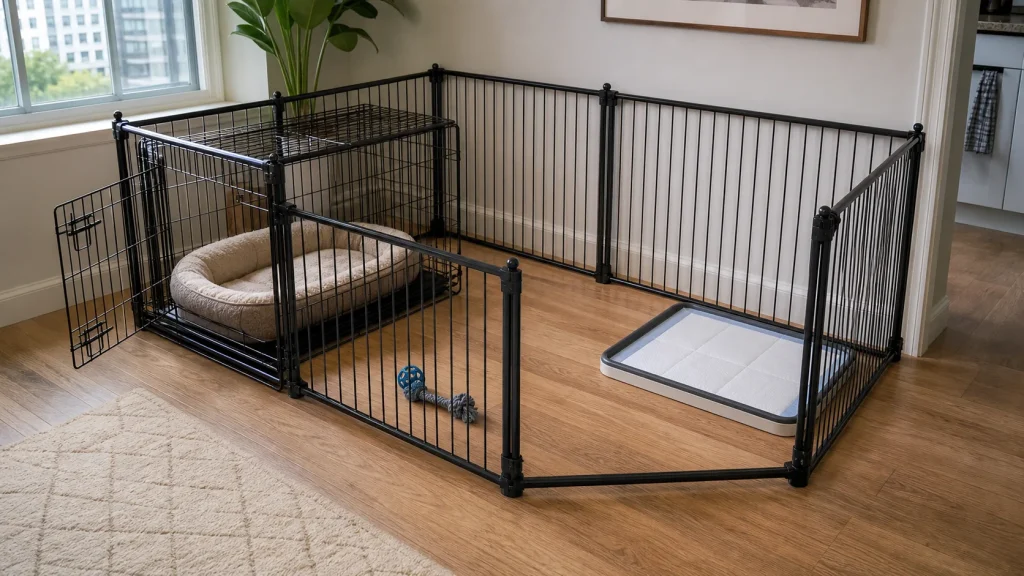
This is where the “Playpen + Pee Pad” Hybrid Schedule comes in. It utilizes a secure Puppy playpen attached to an open Wire dog crate. This setup creates a clear zoning system: a cozy bedroom/sleeping zone (the crate) and a separate bathroom/play zone (the playpen floor with a puppy training pad).
Step-by-Step Hybrid Routine
Step 1: Morning Prep (6:00 AM – 7:45 AM)
Follow the same high-energy morning routine as Method 1: immediate outdoor potty, breakfast, active play, and a second outdoor potty trip. The goal is to make sure they have fully emptied their bowels and bladder outside before you leave.
Step 2: Setting up the Sanctuary (7:45 AM)
- The Bedding Zone: Set up your wire dog crate with the door secured in the open position, letting it sit inside or attach directly to the playpen. Place comfortable, washable bedding inside.
- The Activity Zone: In the center of the playpen, leave a few puzzle toys or frozen chew items to keep their brain active.
- The Bathroom Zone: On the opposite side of the playpen, far away from the crate and food area, lay down a heavy-duty, leak-proof puppy training pad. Secure it in a plastic holder so they don’t shred it out of boredom.
Step 3: The Long Absence (8:00 AM – 5:00 PM)
While you are away, your puppy will naturally alternate between napping inside the open crate and waking up to play in the pen. When their bladder alerts them, they will naturally move away from their bed to the furthest point in the pen to use the puppy pee pad. While this means you are teaching them that it is okay to eliminate indoors, it is a necessary compromise that keeps them safe and clean.
Step 4: The Outdoor Transition Phase (5:00 PM – Bedtime)
When you get home, immediately take them outside to reinforce that outdoor grass is still the preferred bathroom. For the rest of the evening, do not rely on the playpen. Keep them close to you and take them outside every 45 minutes to build their outdoor association.
Method 3: The “Split-Shift” Schedule for Couples
If you live with a partner, roommate, or family member who also works, you have a massive advantage. You don’t need to rely solely on puppy pads or external dog walkers. Instead, you can coordinate your work schedules to create a “Split-Shift” routine. By staggering your departure and arrival times, you can easily reduce your puppy’s solo crate time down to a very manageable 3 to 4 hours.
Step-by-Step Split-Shift Routine
Partner A: The Early Bird Shift (6:00 AM – 2:30 PM Work Hours)
- 6:00 AM: Partner A wakes up, takes the puppy out, feeds them breakfast, and does the morning play/training session.
- 7:00 AM: Partner A leaves for work. The puppy is placed back in the crate. Partner B is still asleep or preparing for a later start.
Partner B: The Late Start Shift (9:30 AM – 6:00 PM Work Hours)
- 8:30 AM: Partner B wakes up, takes the puppy out for a mid-morning potty break, and lets them stretch their legs inside the house.
- 9:15 AM: Partner B gives the puppy a small snack or frozen toy and puts them back into the crate.
- 9:30 AM: Partner B leaves for work.
The Mid-Day Hand-Off (3:30 PM)
- 3:30 PM: Partner A arrives home from work, ending the puppy’s solo crated stretch of only 6 hours (which was interrupted by Partner B in the morning). Partner A immediately takes the puppy out for a long potty and play session, maintaining their 8 week puppy potty training schedule.
By using this tag-team approach, you maximize your puppy’s human interaction during their crucial early weeks, fast-tracking their socialization and potty training without needing to pay for external help.
Essential Gear to Make Your Workday Stress-Free (Expert-Tested)
Over my decade-long career testing pet products, I have seen hundreds of flashy gadgets that promise to train your dog overnight. Let me share some industry truth: most of them are garbage. When you are managing an 8 week old puppy schedule for working owners, you do not need Bluetooth-enabled water fountains; you need heavy-duty, highly functional, and biologically sound management tools.
If you want to keep your home clean and your puppy safe while you are at the office, these are the five essential products that have consistently outperformed the competition in my real-world stress tests.
1. The Foundation: MidWest Homes for Pets iCrate (with Divider Panel)
Why it’s essential: A Wire dog crate is non-negotiable for housebreaking. However, the biggest mistake working owners make is buying a crate that is too large for their 8-week-old puppy. If the crate is too big, your puppy will sleep in one corner and use the other corner as a bathroom. This completely derails your 8 week puppy potty training schedule.
My Expert Tip: Buy a crate that features a movable divider panel. This allows you to adjust the interior space as your puppy grows. At 8 weeks old, they should only have enough room to stand up, turn around, and lie down comfortably. This activates their natural instinct to keep their sleeping den clean.
2. The Play Area: BestPet 8-Panel Heavy Duty Pet Playpen
Why it’s essential: If you are utilizing Method 2 (the hybrid schedule because you are gone for 8 hours), you need a heavy-duty, stable metal Puppy playpen. Avoid cheap plastic pens; an energetic, chewing puppy can easily tip them over or chew through the interlocking joints.
My Expert Tip: Securely zip-tie the open wire door of your dog crate directly to one of the playpen panels. This prevents the puppy from pushing the crate away and trapping themselves in a tight gap between the pen and the crate wall while you are at work.
3. The Distraction: KONG Classic Puppy Rubber Toy
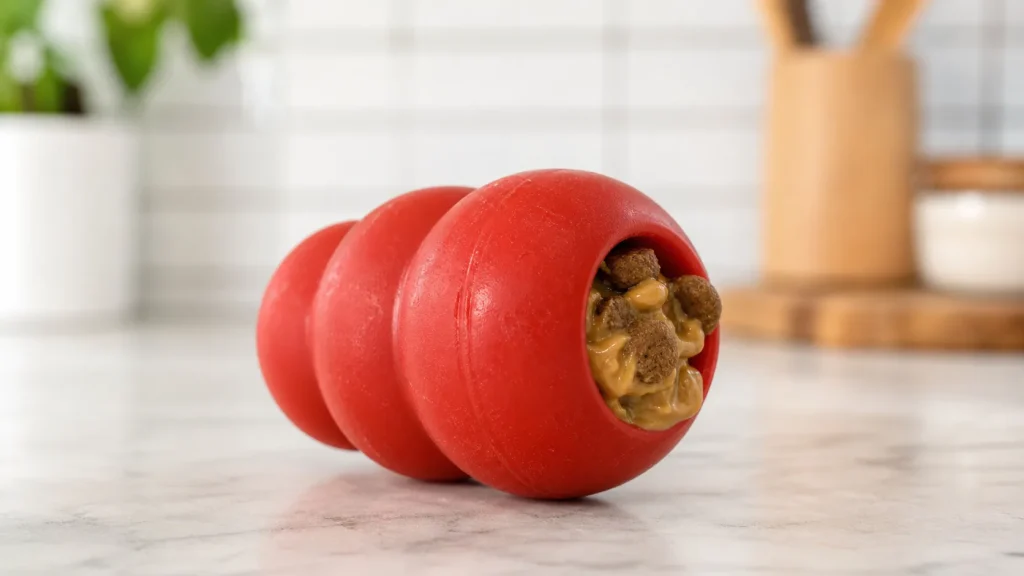
Why it’s essential: Separation anxiety is triggered by the sudden departure of the owner. You need to change your puppy’s association with you walking out the front door from a negative event to a positive, highly rewarding event. The classic KONG toy is the ultimate tool for this.
My Expert Tip: Do not just give them an empty KONG. Stuff it with their morning portion of wet puppy food mixed with a tiny bit of dog-safe peanut butter, and freeze it overnight. When you leave for work, hand them this frozen treat. The intensive licking and chewing action releases endorphins in their brain, which naturally calms them down and tires them out, leading to a peaceful morning nap.
4. The Peace of Mind: Furbo 360° Dog Camera
Why it’s essential: The biggest source of stress for working owners is the unknown. Is my puppy whining? Did they have an accident? A high-quality, wide-angle pet camera with two-way audio and local barking alerts is a lifesaver.
My Expert Tip: Do not use the talk-back feature to scream at your puppy if they are whining; this will only increase their confusion and anxiety. Instead, use the camera to monitor their sleep-wake cycles. If you notice they consistently wake up and get restless at 11:30 AM, you can coordinate your mid-day dog walker to arrive exactly at that time, preventing them from escalating into a state of panic.
5. The Cleanup Crew: Nature’s Miracle Advanced Enzymatic Stain & Odor Remover
Why it’s essential: At 8 weeks old, accidents are guaranteed to happen. Standard household surface cleaners may mask the smell to human noses, but they leave behind microscopic urea salts. A dog’s highly sensitive sense of smell will detect these salts, signaling to them that “this spot is a designated bathroom.”
My Expert Tip: Always use a dedicated Enzymatic cleaner. The live enzyme cultures in these formulas physically break down the biological proteins in puppy urine and feces, completely erasing the scent trace so your puppy doesn’t return to soil the same carpet spot again.
How to Handle the Post-Work “Puppy Witching Hour”
Many working owners arrive home at 5:00 PM expecting a warm, gentle cuddle session with their puppy. Instead, they walk through the door and are met with what trainers call the “Puppy Witching Hour” (or the “Zoomies”). Your puppy might run laps around the living room, bark frantically, growl playfully, and bite viciously at your hands, feet, and pants.
As a behavioral specialist, I can assure you this is not aggression. This behavior is a direct biological reaction to two factors: pent-up physical energy from being confined during the workday, and extreme overtiredness. Just like human toddlers, when puppies are exhausted, they lose the ability to regulate their impulses.
The 3-Step Strategy to De-escalate the Madness:
- Avoid High-Excitement Play: When you walk in, do not immediately play intense games of tug-of-war or run around chasing your puppy. This raises their adrenaline even further. Instead, take them straight outside for a quiet potty break, using a calm, low voice.
- Engage Their Nose (Decompression): Scent-work is a natural sedative for dogs. Instead of a high-energy chase, scatter a handful of their dinner kibble in the grass or hide it inside a snuffmat indoors. Sniffing lowers a dog’s heart rate and helps transition their brain from a state of hyper-arousal to a calm, focused state.
- Enforce an Evening Nap: If your puppy has been awake, playing, and biting for more than an hour after you get home, they are likely overtired. Do not hesitate to put them back into their quiet Wire dog crate with a safe chew toy for a 1-hour enforced evening nap. This resets their nervous system and ensures a peaceful evening for everyone.
Frequently Asked Questions (FAQ)
Q: How long can an 8-week-old puppy be left alone?
A: If kept in a closed Wire dog crate, an 8-week-old puppy should not be left alone for more than 2 to 3 hours maximum. If they are in a spacious, secure Puppy playpen setup with a designated puppy training pad, they can be left for 4 to 6 hours, though this is not ideal for rapid housebreaking.
Q: Should I leave food and water in the crate while at work?
A: No. Never leave bowls of food or water inside a closed crate. Not only will they likely spill it, creating a wet and cold sleeping environment, but constant access to water will guarantee they suffer a bladder accident within 30 minutes. Water should only be provided during active, supervised play sessions outside of the crate.
Q: Will my puppy hate the crate if I work full-time?
A: No, as long as you make the crate a positive, highly rewarding space. Never use the crate as a place of punishment. By feeding them their meals inside the crate and offering high-value treats like frozen stuffed KONGs only when they go inside, they will learn to view the crate as their safe, secure bedroom.
Key Takeaways for Working Puppy Owners
- Consistency is the Secret to Success: Stick to the exact same feeding, potty, and nap times every single day. Puppies thrive on predictable routines.
- Manage the Environment: Do not give your puppy the opportunity to fail. Use crates and playpens to keep them safe and prevent bad habits from forming while you are away.
- Quality Over Quantity: Spending 15 minutes of focused, calm mental training and structured play with your puppy is far more beneficial than letting them run loose and unsupervised for two hours.
- Be Patient with the Process: The 8-week-to-12-week stage is physically demanding. By implementing these realistic schedules, you are setting a rock-solid behavioral foundation that will last for the rest of your dog’s life.